










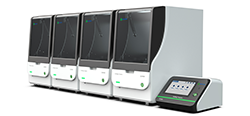



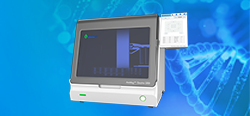





















eBlot ® Protein Transfer System
For convenient, fast & cost-effective protein transfer  | · Fast - complete protein transfer in 7 to 10 minutes
· Sensitive - high transfer efficiency as existing methods · Convenient - no needs for external power supply and added buffers
· Safe - no methanol required, eliminating special treatment before disposal
· Economical - lower cost per gel than other fast protein blotting systems
|
| | eBlot ® semi-dry blotting system
|
| | | | | | The eBlot ® Protein Transfer System is based on the proprietary fast semi-dry blotting technique developed by GenScript. To use the eBlot ® Protein Transfer System for rapid protein blotting, assemble the eBlot ® Protein Transfer Pad with your pre-run gel and the membrane on the eBlot ® Protein Transfer Device. A certain definite voltage between electrodes allows for rapid and directional movement of negatively charged protein molecules from the gel matrix onto the membrane within 7-10 minutes.
|  | | Figure 1. System Mechanism The eBlot ® Cathode Pad and eBlot ® Anode Pad act as ion reservoirs that contain the appropriate anode and cathode buffers. A certain definite voltage between electrodes drive a rapid and directional movement of negatively charged protein molecules from the gel matrix onto the membrane.
| | | Shortened workflow increases your productivity | | | | | | | The eBlot ® Protein Transfer System is faster and provides superior transfer quality compared to the conventional semi-dry western transfer and wet transfer systems (Table 1, Figure 2 and 3).
|
| Table 1. Fast protein transfer with the eBlot ® | 
|
| | High and consistent protein transfer efficiency | |
| | | | | In addition to ease and convenience, the eBlot ® Protein Staining System provides higher detection sensitivity comparable to that of traditional protein transfer methods (Figure 3). |
 | | Figure 2. Higher transfer quality of eBlot ® Protein Transfer System
(A) Comparison of protein transfer between eBlot ® Protein Transfer System and a semi-dry western transfer method. (B) Comparison of protein transfer between eBlot ® Protein Transfer System and a tank wet western transfer method. Proteins were separated with Genscript Express™ PAGE Gels 8-16% and transferred to nitrocellulose . (A) Lanes 1-5 and 6-10: 0.313 µl, 0.625 µl, 1.25 µl, 2.5 µl, and 5.0 µl Genscript EasyWestern Protein Standard (22, 40, 60, 85, and 120 kDa); (B) Lanes 1-5 and 6-10: 5.0 µl, 2.5 µl, 1.25 µl, 0.625 µl, and 0.313 µl Genscript High Range EasyWestern Protein Standard (60, 85, 120, 160 and 200 kDa). |
| | Optimized self-contained system offers easy and convenient procedures | | | | | | The eBlot ® Protein Transfer System is created as a self-contained system. All you need to do is to simply assemble the eBlot ® Protein Transfer Pads and membrane together with the pre-run gel, then press the run button (Figure 3).
Figure3. eBlot ® Protein Transfer System
|
| | Suitable for various types of mini gels | | | | | | | The eBlot ® Protein Transfer System is designed to work with multiple types of mini polyacrylamide gels, including Tris-Glycine, Bis-Tris, Tris-Tricine, and Tris-Acetate gels, etc.
| | | | | Available Video | | Watch the video and see the eBlot ® System in action | |