IVD Raw Materials
Resources » Technical Resource Centers » Protein Technical Resources » Technical Notes » IgA Antibody
What is IgA Antibody
IgA antibody is the most abundant antibody class in human serum and has a unique role in mediating immunity. IgA is a polyvalent antibody that is translocated to mucosal surfaces as the first line of defense against infections. Most of the secreted IgA lines the mucosal surfaces including respiratory, digestive and genitourinary tracts to protect against pathogens while maintaining gut homeostasis.
The importance of IgA in pathogen defense is highlighted by the numerous mechanisms used by pathogens to neutralize sIgAs, including sIgA-binding proteins and sIgA-specific proteases produced by certain penumococci, neisseriae and haemophilus species of bacteria.
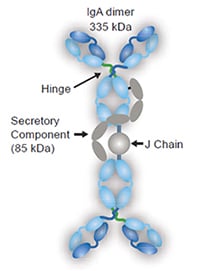
IgA antibodies consists of heavy (H) and light (L) chains. Each H chain is comprised of the Constant region (Cα1, Cα2, Cα3), hinge region and the Variable (V) region. Light chains consists of the CL and Vκ or Vλ elements. Altogether the combined molecular weight of IgA antibody is ~160 kDa. IgA antibodies possess a unique 18-amino acid tail piece at the C-terminus of the H chains which is key for oligomerization. As in the case of IgM Antibody, IgA antibody monomers routinely dimerize with the help of a 15 kDa J chain. The secreted form of IgA (sIgA) is usually dimeric and contains an additional 80-85 kDa component.
Figure 1: IgA Antibody Schematic
IgA antibody has two isotypes: IgA1 and IgA2. In human serum the ratio of IgA1:IgA2 is approximately 9:1. There are quite a few sequence differences in the two isotypes but the most profound difference is in the hinge region. IgA1 hinge regions consists of 16-18 amino acids whereas IgA2 hinge regions are much shorter at around 5 amino acids. The extended hinge region of IgA1 contains 3-6 O-linked glycosylation sites. IgA2 has two allotypes – IgA2m(1) and IgA2m(2) unlike in other antibody classes, there are no disulfide bonds linking LC and HC in IgA
Human IgA antibodies bind five different receptors that serve various functions . See table below for details.
| Receptor | Location | Function |
|---|---|---|
| FcαRI | Neutrophils, Monocytes |
|
| Fcα/μR | Pre-germinal B cells, Follicular dendritic cells |
|
| pIgR | Epithelial cells, liver, lung, small intestine |
|
| Asialoglycoprotein | Liver |
|
| Transferrin | Kidney |
|
There are two potential advantages of using IgA antibody as therapeutic.
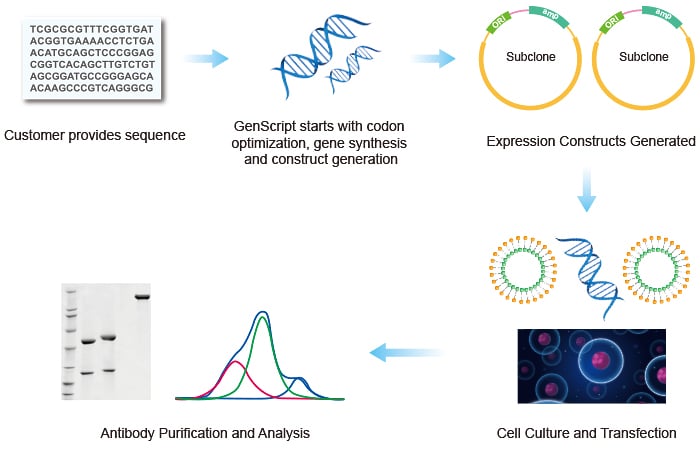
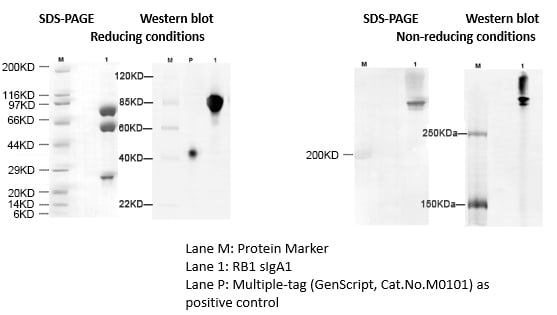
GenScript production team scientists can produce a variety of antibody formats including IgG, IgA, IgM, Bispecific IgG, scFv, BiScFv and Fc fusion proteins. GenScript scientists perform a variety of optimization experiments and leverage years of collective experience to achieve high yields and deliver high quality antibodies to clients. A generic IgG1 production scheme is listed below followed by gel images of IgA production. In order to protect client and project information, experimental details and optimization parameters have been withheld.
Purified IgA Antibody SDS-PAGE and Western Blot under reducing (left) and non-reducing (right) conditions.
You can also view our Recombinant Antibody Service Selection Guide to identify services that are the best match for your application.
Click the quote button, provide service information and submit
Our Technical Account Manager will contact you with 24 hours to finalize quote
Your review and approve final order details and price
You provide credit card/PO information and order is placed
Project is initiated inmediately
Our Project Manager will be in contact with you to provide updates
Our customer service repsentatives are available 24 hours a day, Monday through Friday, to assist you.