Overview

Single-stranded DNA (ssDNA, also known as ssOND) has been proven to be the most effective homology-directed repair (HDR) template for CRISPR-mediated gene knock-ins, offering high editing efficiency and reduced off-target integration. GenScript provides high-quality, sequence-verified ssDNA in both linear and circular formats to maximize the editing efficiency of your CRISPR experiments.

Why Use ssDNA For Your HDR Knock-in Template?

  • High editing efficiency
  • Lower cytotoxicity
  • Reduced off-target integration
  • Increased editing accuracy
  • Ideal for editing primary cells and stem cells
  • Ideal for developing transgenic animal model

Advantages of GenExact ssDNA

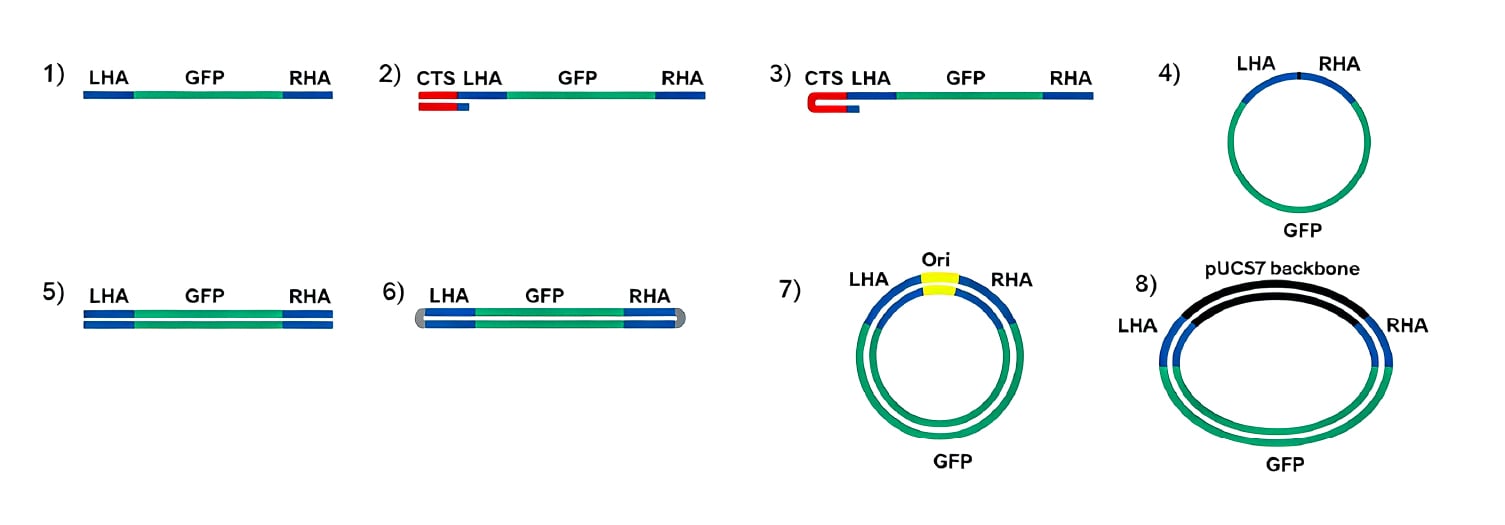
  • Linear ssDNA (ssDNA)
    • 101 – 5000 nt insert length capacity, with sequence verification by Sanger sequencing in the final ssDNA product
    • Up to 100 mg delivery quantity
  • Circular ssDNA (cssDNA)
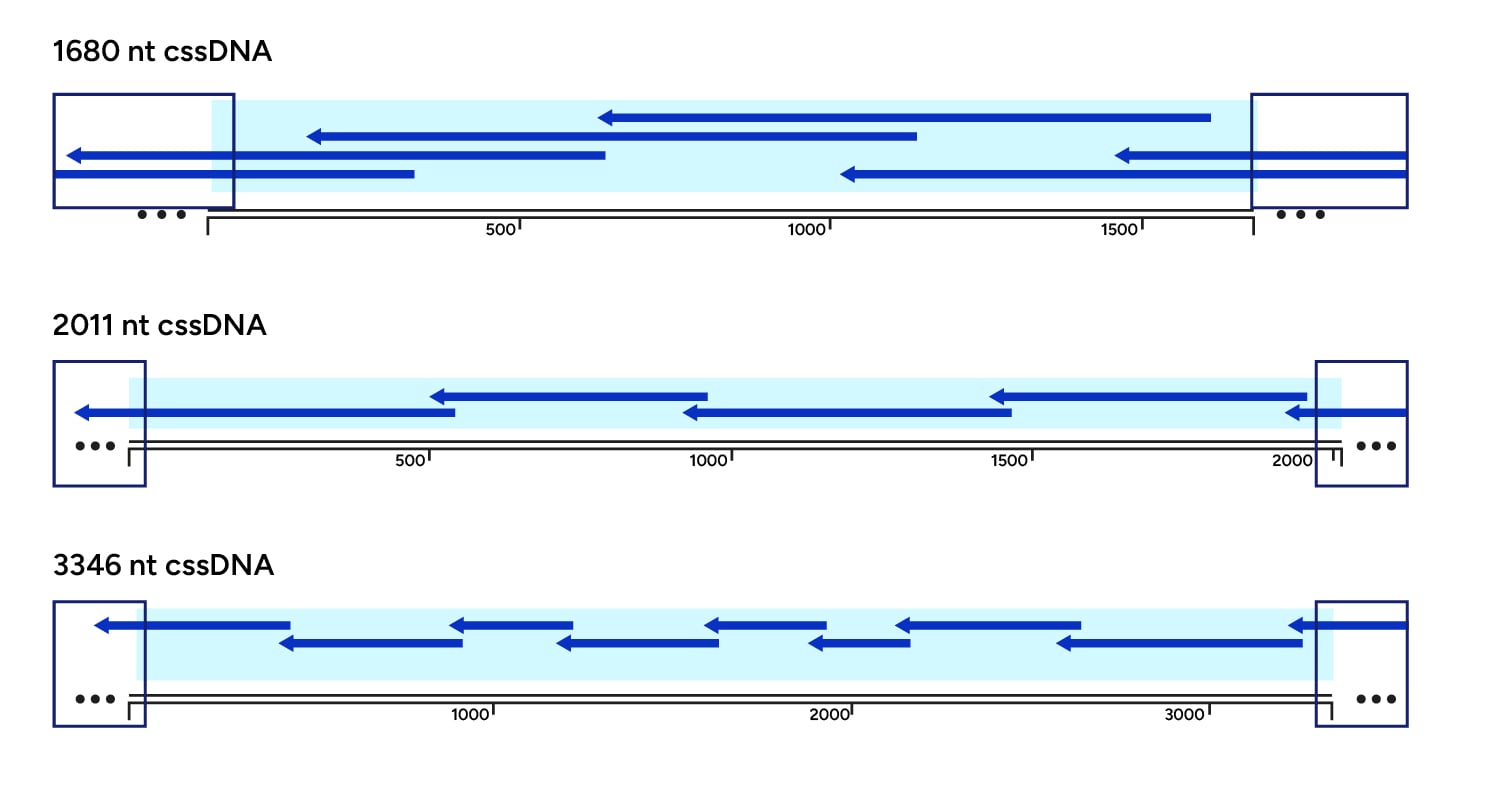
    • 201 – 4000 nt insert length capacity, with sequence verification by Sanger sequencing in the final cssDNA product
    • Up to 10 mg delivery quantity
  • No harsh chemicals required. Our enzymatic synthesis approach ensures non-detectable levels of dsDNA and minimal DNA base damage
  • Free lifetime gene template storage, supporting faster and more cost-effective reordering
  • Leveraging 20+ years of experience in synthesizing difficult genes as ssDNA templates
  • Full cGMP and IND-enabling options are also available. Learn more here

Looking for ssDNA or dsDNA for non-CRISPR applications? Check out our Custom DNA Oligos Synthesis here.

Testimonials

KansasState

Dr. Theodore Roth

the Marson Lab at University of California San Francisco

Long ssDNA sequences are difficult to produce in the lab, especially at the high concentrations necessary for gene editing experiments. We were able to successfully integrate large DNA sequences into primary human T cells using GenScript's long ssDNA product.

GenExact™ Linear ssDNA

Quantity Length (nt)
(µg) <200 500 1000 2000 3000 4000 5000
3 N/A $400 $675 $1,300 $1,950 $2,450 $2,950
5 $500 $800 $1,500 $2,250 $2,850 $3,450
10 $130 $650 $975 $1,700 $2,500 $3,200 $3,900
20 $150 $750 $1,100 $1,900 $2,800 $3,600 $4,400
50 $180 $960 $1,280 $2,120 $3,160 $4,293 $5,228
100 $220 $1,050 $1,444 $2,325 $3,450 $4,475 $5,700

GenExact™ Circular ssDNA Get Quote

Delivered in as fast as 3 weeks.

* We also offer <101 nt ssDNA through our DNA Oligo Chemical Synthesis Service.

Linear ssDNA QC Services

Test Specification Detection Method Release Criteria
Purity Agarose gel electrophoresis Single band
Sequence accuracy Sanger sequencing 100% sequence alignment
Optical density Spectrophotometer at 260 nm/230 nm ≥ 2.0

Circular ssDNA QC Services

Test Specification Detection Method Release Criteria
Appearance Visual inspection Powder
Clear, colorless solution
Concentration UV Absorbance method ±10%
Purity Agarose gel electrophoresis ≥80%
Identification Sanger Sequencing Identity Confirmed

Additional QC tests are available upon request. Contact us!

GenScript also offers full cGMP and IND-enabling ssDNA, linear dsDNA, and GenCircle™ services, accelerating your transition to the clinic!

Cell Therapy

State-of-the-art facility

Clean suite with class A isolator in a class C background

Gene Therapy

Comprehensive QA/QC & documentation

Supporting the IND filing process

Vaccine

All-encompassing non-viral solutions

RUO to cGMP linear ssDNA, dsDNA and miniaturized circular dsDNA

Learn More

More about ssDNA for CRISPR knock-ins

CRISPR based gene insertion, replacement, or correction

Mechanism of CRISPR HDR based gene editing

How HDR-based CRISPR gene editing works

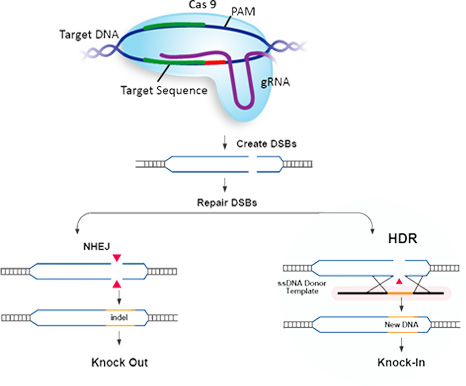
CRISPR/Cas9 is currently the most widely used to system for gene editing due to its simplicity, efficiency, precision, and versatility. In this system, the guide RNA (gRNA) recognizes the protospacer adjacent motif (PAM) sequence on the target DNA. Upon forming a complex with Cas9, the enzyme exerts its endonuclease function to create a double-stranded break (DSB). This triggers one of two primary mechanisms for repair: non-homologous end-joining (NHEJ), which introduces mutations at the DSB site, or homology-directed repair (HDR), which enables the insertion of donor DNA at the break site to achieve gene knock-in.

Double-stranded DNA (dsDNA) has traditionally been used for HDR templates. However, recent studies have demonstrated that single-stranded DNA (ssDNA or ssODN) is the most effective HDR template for CRISPR-based gene insertion, replacement, and correction1-5. Compared to dsDNA donors, ssDNA has shown significantly improved editing efficiency and specificity, along with reduced off-target integration- especially when editing primary cells and stem cells, or developing transgenic animal models.

Resources

HDR Templates Flyer

HDR Templates Flyer

Free Download

FAQs

Get in Touch
with GenScript
CRISPR Experts

Get in Touch with GenScript Custom CRISPR Experts
Please enter a valid first name.
Please enter a valid last name.
Please enter a valid email name.
Please select a valid industry.
Please select a valid country.
Please enter a valid Zipcode.
Please enter a valid institution/company.
Please enter a message in the textarea.

REQUEST A QUOTE