




































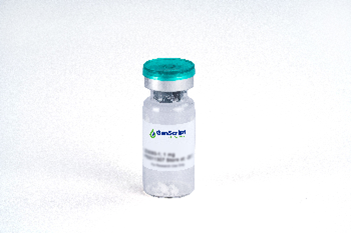
PD-1, His, Human
| $200.00 | |
| Z03424-100 | |
|
|
|
|
|
|
|
|
|
| Ask us a question | |
IVD Raw Materials
| $200.00 | |
| Z03424-100 | |
|
|
|
|
|
|
|
|
|
| Ask us a question | |
| Species | Human | ||||
| Protein Construction |
|
||||
| Purity | > 95% as analyzed by SDS-PAGE | ||||
| Endotoxin Level | < 0.2 EU/μg of protein by gel clotting method | ||||
| Biological Activity | Immobilized PD-1,His, Human at 2.0 μg/ml can bind PD-L1 Fc Chimera, Human (Cat. No.: Z03371).Immobilized PD-1,His, Human at 0.5 μg/ml can bind Keytruda. | ||||
| Expression System | HEK 293 | ||||
| Apparent Molecular Weight | 25~40 kDa, on SDS-PAGE under reducing conditions. | ||||
| Formulation | Lyophilized from a 0.2 μm filtered solution in PBS, 5% trehalose and mannitol. | ||||
| Reconstitution | It is recommended that this vial be briefly centrifuged prior to opening to bring the contents to the bottom. Reconstitute the lyophilized powder in ddH₂O or PBS up to 100 μg/ml. | ||||
| Storage & Stability | Upon receiving, this product remains stable for 6 months at lower than -70°C. Upon reconstitution, the product should be stable for 1 week at 4°C or for 3 months at -20°C. For long term storage it is recommended that a carrier protein (example 0.1% BSA) be added. Avoid repeated freeze-thaw cycles. |
»
»
Immobilized PD-1,His, Human at 2 μg/mL can bind PD-L1 Fc Chimera, Human(Cat.No.Z03371) with a linear range of 24-390ng/mL. »
Immobilized PD-1,His, Human at 0.5 μg/mL can bind Keytruda(Merck) with a linear range of 0.017~1.37ng/mL. »
| Target Background | Programmed death (PD-1) is an immunoinhibitory receptor that belongs to the CD28 family and is expressed on T cells, B cells, monocytes, natural killer cells, and many tumor-infiltrating lymphocytes (TILs); PD-1 is a type I membrane protein of 268 amino acids and which structure includes an extracellular IgV domain followed by a transmembrane region and an intracellular tail. The intracellular tail contains two phosphorylation sites located in an immunoreceptor tyrosine-based inhibitory motif and an immunoreceptor tyrosine-based switch motif, which suggests that PD-1 negatively regulates TCR signals. This is consistent with binding of SHP-1 and SHP-2 phosphatases to the cytoplasmic tail of PD-1 upon ligand binding. It has 2 ligands that have been described PD-L1(B7H1) and PD-L2(B7-DC); PD-1 induction on activated T cells occurs in response to PD-L1 or L2 engagement and limits effector T-cell activity in peripheral organs and tissues during inflammation, thus preventing autoimmunity.Recombinant Human PD-1 produced in HEK293 cells is a polypeptide chain containing 149 amino acids with C-terminal 6×His. A fully biologically active molecule, rhPD-1 has a molecular mass of 30-40 kDa analyzed by reducing SDS-PAGE and is obtained by chromatographic techniques at GenScript. |
| Synonyms | PD-1; CD279; PDCD1; Programmed cell death 1 |
For laboratory research use only. Direct human use, including taking orally and injection and clinical use are forbidden.