





































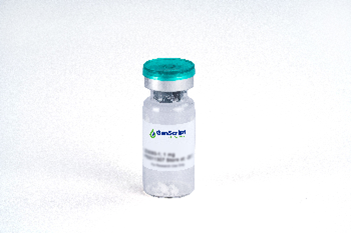
TGF-β 2, Mouse
| $225.00 | |
| Z03432-10 | |
|
|
|
|
|
|
|
|
|
| Ask us a question | |
IVD Raw Materials
| $225.00 | |
| Z03432-10 | |
|
|
|
|
|
|
|
|
|
| Ask us a question | |
| Species | Mouse | |
| Protein Construction |
|
|
| Purity | ≥ 95% as analyzed by SDS-PAGE | |
| Endotoxin Level | < 1 EU/μg of protein by LAL method | |
| Biological Activity | Immobilized Recombinant Mouse TGFBR2 (C-Fc) at 5μg/ml (100 μl/well) can bind TGF-β 2, Mouse. | |
| Expression System | Human Cells | |
| Apparent Molecular Weight | ~12.7 kDa, on SDS-PAGE under reducing conditions. | |
| Formulation | Lyophilized from a 0.2 μm filtered solution in 4 mM HCl. | |
| Reconstitution | Dissolve the lyophilized protein in 4mM HCl. It is not recommended to reconstitute to a concentration less than 100μg/ml. | |
| Storage & Stability | Upon receiving, this product remains stable for 6 months at -70°C or -20°C. Upon reconstitution, the product should be stable for 1 week at 4°C or for 3 months at -20°C. Avoid repeated freeze-thaw cycles. |
| Target Background | Transforming growth factor beta 2 (TGF-β2) is a member of TGF-beta superfamily that shares a characteristic cysteine knot structure. Mice with TGF-β2 gene deletion show defects in development of cardiac, lung, craniofacial, limb, spinal column, eye, inner ear and urogenital systems. All TGF-β isoforms signal via the same heteromeric receptor complex, consisting of a ligand binding TGF-β receptor type II (TβR-II), and a TGF-β receptor type I (TβR-I). Signal transduction from the receptor to the nucleus is mediated via SMADs. TGF-β expression is found in cartilage, bone, teeth, muscle, heart, blood vessels, hematopoietic cells, lung, kidney, gut, liver, eye, ear, skin, and the nervous system. |
| Synonyms | Transforming growth factor beta-2; TGFB2; Polyergin; G-TSF; Glioblastoma-derived T-cell suppressor factor; Cetermin; BSC-1 cell growth inhibitor; TGF-beta-2 |
For laboratory research use only. Direct human use, including taking orally and injection and clinical use are forbidden.