
































FGF-basic, Salmon
| $74.00 | |
| Z03727-10 | |
|
|
|
|
|
|
|
|
|
| Ask us a question | |
IVD Raw Materials
| $74.00 | |
| Z03727-10 | |
|
|
|
|
|
|
|
|
|
| Ask us a question | |
| Species | Salmon | |
| Protein Construction |
|
|
| Purity | ≥ 95% as analyzed by SDS-PAGE | |
| Endotoxin Level | < 0.2 EU/μg of protein by gel clotting method | |
| Biological Activity | EC50 < 1.0 ng/ml as determined by a dose-response proliferation assay using murine Balb/c 3T3 cells. Based on the EC50, the calculated specific activity is approximately > 1.0 × 10⁶ U/mg.. It is recommended to experimentally determine the optimal concentration for each specific application by performing a dose response assay. | |
| Expression System | E. coli | |
| Theoretical Molecular Weight | 17.1 kDa | |
| Apparent Molecular Weight | ~20 kDa, on SDS-PAGE under non-reducing conditions. | |
| Formulation | Lyophilized from a 0.2 μm filtered solution in 7.8 mM Na2HPO4, 1.5 mM KH2PO4, 2.7 mM KCl, 500 mM NaCl. | |
| Reconstitution | Before opening, centrifuge the vial briefly to bring the contents to the bottom. Reconstitute the lyophilized powder in PBS up to 100 μg/ml. | |
| Storage & Stability | Upon receiving, the lyophilized product remains stable for 6 months at lower than -70℃. Upon reconstitution, the product is stable for 1 week at 4℃ or for 3 months at -20℃. Avoid repeated freeze-thaw cycles by making single-use aliquots before the solution is storage at -20℃. |
»
»
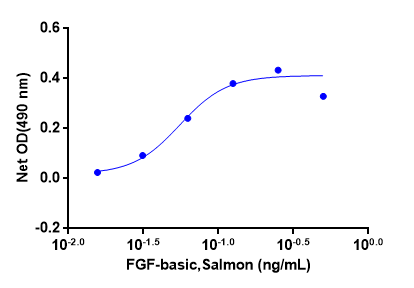
The EC50 as determined by a cell proliferation assay using mice Balb/c 3T3 cells is 0.053 ng/ml. »
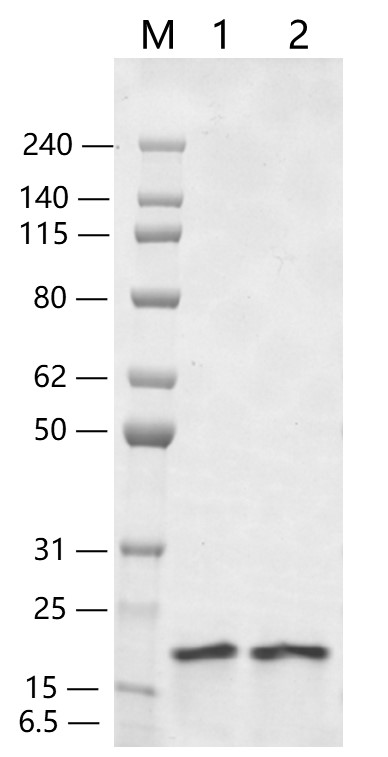
Lane 1: 2 µg of FGF-basic, Salmon, reducing (R)
Lane 2: 2 µg of FGF-basic, Salmon, non-reducing (NR)
The purity is greater than 95% as analyzed by SDS-PAGE
»| Target Background | Fibroblast Growth Factor-basic (FGF-basic), also known as FGF-2, is a pleiotropic cytokine and one of the prototypic members of the heparin-binding FGF family. Like other FGF family members, FGF-basic has the β trefoil structure. In vivo, FGF-basic is produced by a variety of cells, including cardiomyocytes, fibroblasts, and vascular cells. FGF-basic regulates a variety of processes including cell proliferation, differentiation, survival, adhesion, motility, apoptosis, limb formation and wound healing. FGF-basic can be tumorigenic due to its role in angiogenesis and blood vessel remodeling. The angiogenic effects of FGF-basic can produce beneficial cardioprotection during acute heart injury. |
| Synonyms | FGF-2; BFGF; FGFB; FGF basic; |
For laboratory research use only. Direct human use, including taking orally and injection and clinical use are forbidden.