




































Catalog Products » Purification and Analysis Instruments » eStain™ L1 Protein Staining System » eBlot ® L1 Fast Wet Transfer System

eBlot® L1

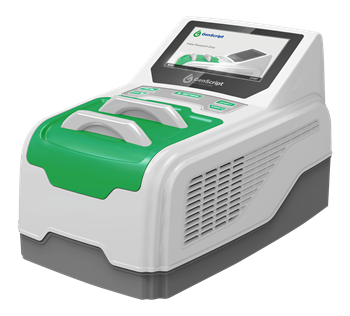
eBlot L1 is a highly efficient wet protein transfer system, which uses a patented technology developed by GenScript. eBlot L1 combines the high stability and efficiency of the traditional wet transfer with the rapidness and convenience of the semi-dry transfer system. The device allows the efficient transfer of small, medium as well as large molecular weight proteins within 15 minutes.
$4980.00
L00686

Ask us a question
Description

eBlot™ L1 is a highly efficient wet protein transfer system, which uses a patented technology developed by GenScript. eBlot™ L1 combines the high stability and efficiency of the traditional wet transfer with the speed and convenience of the semi-dry transfer system. The device allows the efficient transfer of small, medium as well as large molecular weight proteins within 9-17 minutes.  
eBlot™ L1 allows fast and efficient transfer of 1 or 2 mini gels at a time. The system comes with conveniently designed transfer stacks/consumables (sold separately). The setup takes less than 2 minutes and can be performed even with the sponge under a dry state (patent pending). 

Features and Benefits 
• Better transfer efficiency than wet transfer
• High transfer efficiency for large, medium and small proteins
• Fast transfer time of 9-17 minutes
• Easy to assemble, one button operation
• Customizable programs
• Transfer 1 or 2 mini gels at a time
• Long shelf life of consumables
• Highly compatible with different types of precast or homemade gels

EBlot® L1

»

EBlot® L1

»

<
>

Nathan E Tharp, et al. PEX11 mediates intralumenal vesicle formation in peroxisomes. Nature Communications. (2026-04)
Ting-Syuan Lin; Jingting Wan; Jingjin He; Shidong Cui; Yun Huang; Bojian Zhang; Hsi-Yuan Huang; Kexin Zhu; Jihang Chen; Tao Zhang; Shangfu Li; Liao Hu; Yongfei Wang; Hsien-Da Huang; Ping Tang; Yang-Chi-Dung Lin, et al. Arecoline as a Novel Scaffold Targeting the ATAD2 Bromodomain for Cell Cycle Modulation. Pharmaceutics. (2026-01)
Rubing Zou, et al. Quantitative Proteomics and CRISPR/Cas9 Editing Reveal UPR-Mediated Control of Immunoglobulin Homeostasis in Hybridomas. Advanced Science. (2026-01)
Ting-Syuan Lin; Jingting Wan; Jingjin He; Shidong Cui; Yun Huang; Bojian Zhang; Hsi-Yuan Huang; Kexin Zhu; Jihang Chen; Tao Zhang; Shangfu Li; Liao Hu; Yongfei Wang; Hsien-Da Huang; Ping Tang; Yang-Chi-Dung Lin, et al. Arecoline as a Novel Scaffold Targeting the ATAD2 Bromodomain for Cell Cycle Modulation. Pharmaceutics. (2026-01)
Gabrielle C Buck, et al. Identifying and characterizing a missing peroxin-PEX8-in Arabidopsis thaliana. Plant Cell. (2025-07)
Prem Kumar Govindappa, et al. Erythropoietin decreases apoptosis and promotes Schwann cell repair and phagocytosis following nerve crush injury in mice. Cell death & disease. (2025-07)
Shu-Ping Zhang, et al. The Design and Application of Inhibiting Peptide for Rapid In vitro Downregulation of Post-Translational Modifications Levels at a Specific Site. Journal of visualized experiments:JoVE. (2025-06)
Julian Geilenkeuser, et al. Engineered nucleocytosolic vehicles for loading of programmable editors. Cell. (2025-04)
Rahul V G , et al. 4-aminopyridine attenuates inflammation and apoptosis and increases angiogenesis to promote skin regeneration following a burn injury in mice. Cell Death Discov. (2024-10)
Alexandra Unapanta , et al. Endogenous Rab38 regulates LRRK2's membrane recruitment and substrate Rab phosphorylation in melanocytes. J Biol Chem . (2023-10)
Alexia Caillier, et al. T cells Use Focal Adhesions to Pull Themselves Through Confined Environments. biorxiv. (2023-10)
Aleksander Tworak, et al. Rapid RGR-dependent visual pigment recycling is mediated by the RPE and specialized Müller glia. Cell repports. (2023-08)
A Kaitlyn Victor, et al. Analysis and comparisons of gene expression changes in patient- derived neurons from ROHHAD, CCHS, and PWS. Front Pediatr. (2023-05)
Paul Daly, et al. Genome of Uncovers an Extensive Arsenal of Virulence-Related Genes among the Broad-Host-Range Necrotrophic Plant Pathogens. Microbiol Spectr. (2022-08)
Cong-Rong Li, et al. Fidgetin knockdown and knockout influences female reproduction distinctly in mice. Journal of biomedical research. (2022-07)
Izzy Owen, et al. The oncogenic transcription factor FUS-CHOP can undergo nuclear liquid-liquid phase separation. J Cell Sci. (2021-09)
Alba Timón-Gómez, et al. Protocol for the Analysis of Yeast and Human Mitochondrial Respiratory Chain Complexes and Supercomplexes by Blue Native Electrophoresis. STAR Protoc. (2020-09)
Alexanne Cuillerier, et al. Hybrid Clear/Blue Native Electrophoresis for the Separation and Analysis of Mitochondrial Respiratory Chain Supercomplexes. J Vis Exp. (2019)
Learn More
Back