IVD Raw Materials
Resources » Learning Center » Research Digest » Evaluating a New Immunotherapy Strategy: Targeting Solid Tumors with Recombinant Dimeric IgA Antibodies
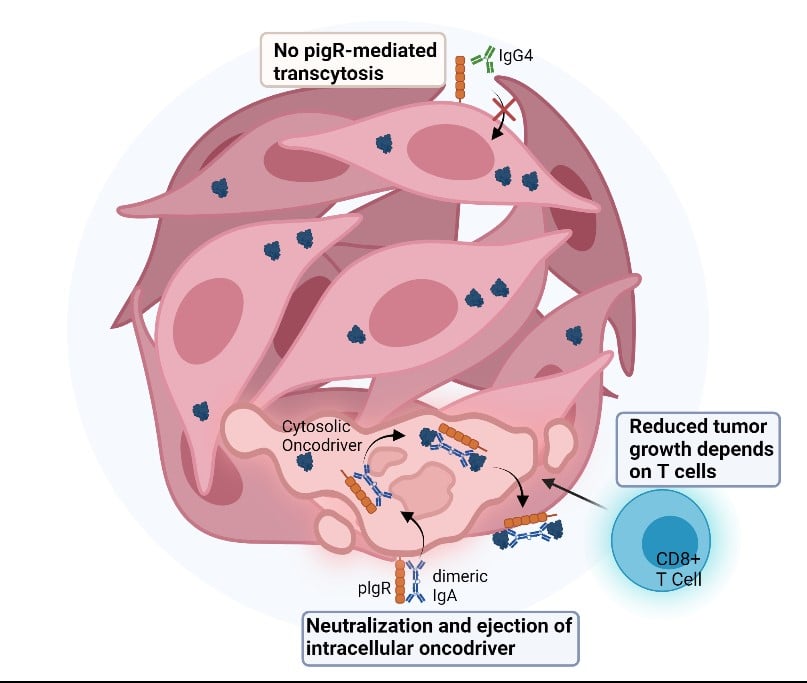
Dimeric IgA antibodies targeting cytosolic oncogenic drivers are emerging as a therapeutic strategy with potential against solid cancers. Biswas and colleagues show through in vitro studies that anti-KRASG12D dimeric IgA antibodies effectively expel this oncodriver from tumor cells, reducing proliferation. Moreover, they demonstrate that in vivo anti-KRASG12D dimeric IgA antibodies can reduce tumor growth by boosting CD8+ T cell cytotoxicity.1
Antibody drugs are generally considered too large to reach intracellular protein targets and achieve therapeutic efficacy. Therefore, small-molecule drugs have been more commonly developed and deployed against cytosolic targets of interest. Antibodies, however, offer advantages unparalleled by small-molecule inhibitory drugs, such as unique target specificity, reduced toxicity, and longer half-life.
Recently, IgA antibodies derived from tumor-infiltrating B cells have emerged as essential players in anti-tumor responses. In a mechanism inaccessible to IgG antibodies, tumor-specific dimeric IgA antibodies can traverse cellular membranes, infiltrating tumor cells. Once internalized, through the IgA/IgM polymeric immunoglobulin receptor (PIGR)-mediated process commonly called “transcytosis,” IgAs may target and modulate signaling pathways to reduce tumorigenesis and promote CD8+ T cell-mediated cytotoxicity.2,3
This mechanism has opened the door to developing new immunotherapy strategies leveraging dimeric IgA antibody drugs against tumor-promoting targets, also known as oncogenic drivers. Yet, some questions remain about the feasibility of targeting intracellular oncodrivers with dimeric IgA antibodies. Specifically, whether these antibodies could sufficiently co-localize with their intended oncogenic targets within tumor cells to achieve therapeutic outcomes and their stability and safety remain unresolved.
To start addressing some of these critical questions, in their most recent work, Biswas and colleagues have focused on KRAS mutations, which are frequent oncodrivers in several solid tumors. Specifically, the KRASG12D mutation is prominently involved in colon, pancreatic, lung, and endometrial cancers.

Biswas and team first tackled antibody specificity, demonstrating that recombinant dimeric IgA1 and monomeric IgG4 antibodies could bind to KRASG12D but no other KRAS mutations or the wild-type form. Yet, as expected, only the dimeric IgA1 anti-KRASG12D and not IgG4 antibodies could access the intracellular space of cancer cells expressing PIGR. Significantly, once inside cancer cells, only the dimeric IgA1 anti-KRASG12D and not a control IgA dimer disrupted KRASG12D localization and trafficking.
High-resolution confocal microscopy analysis revealed specific aggregation between anti-KRASG12D dimeric IgA1 and the mutant protein. Moreover, immunoprecipitation of various endosomal compartments from KRASG12D-expressing cancer cells, following treatment with the specific dimeric IgA1, demonstrated a shift in endosomal trafficking for the mutant protein. Rather than localizing to recycling endosomes, the KRASG12D protein became preferentially sequestered into early and late endosomes with the dimeric IgA1 antibody.
These findings, together with oncodriver fragments in cancer cell supernatants, detected only following anti-KRASG12D dimeric IgA1 treatment, led Biswas and colleagues to propose a co-transcytosing mechanism. In such a process, antibody binding to the KRASG12D protein would occur near the cellular membrane, followed by PIGR-mediated engulfing of the complex and endosomal co-trafficking through the IgA secretory pathway, ultimately ejecting oncodrivers from tumors. This approach's therapeutic potential is significant because cancer cells expressing KRASG12D protein showed reduced proliferation following anti-KRASG12D dimeric IgA1 treatment.
For this strategy to be therapeutically effective, dimeric IgA antibodies must bind and induce sufficient transcytosis of the targeted oncodrivers. Therefore, Biswas’s team next addressed the efficacy of recombinant antibodies in vivo by leveraging various tumor-bearing mouse models. They found that compared to controls, such as a non-specific IgA and anti-KRASG12D IgG4 antibodies, intratumoral or intraperitoneal administration of anti-KRASG12D dimeric IgA1 antibodies significantly reduced tumor growth in different tumor-bearing mouse models. Promisingly, human recombinant anti-KRASG12D dimeric IgA1 antibodies could be detected at tumor sites following their administration through the intraperitoneal route, confirming their capacity for tumor targeting and infiltration.
Lastly, Biswas and colleagues demonstrated that this strategy can effectively reduce tumor progression across several lung cancer models in a mechanism that is CD8+ T cell-dependent. Because PIGR and KRAS mutations, including KRASG12D, are frequently co-expressed in lung carcinomas, such as non-small cell lung cancer (NSCLC) and others, this approach could have far-reaching therapeutic value.
Interestingly, Biswas and colleagues found a substantial disparity in the efficiency of the small molecule drug, KRASG12D-selective inhibitor MRTX1133, and that of anti-KRASG12D dimeric IgA1 antibodies. While the small molecule inhibitor could reduce tumor growth to the same extent as the antibody, it only did so after daily administration, requiring 20 doses. In comparison, only five doses of antibody were needed.
These studies have leveraged various recombinant antibodies and KRASG12D-driven cancer models with positive PIGR expression to elucidate the therapeutic potential of dimeric IgA antibody transcytosis. Biswas and colleagues have shown that dimeric IgA antibodies can efficiently reach and expel relevant cytosolic oncodrivers, promoting their neutralization while stimulating anti-tumor T-cell responses. Given the widespread expression of PIGR and the frequent involvement of KRAS mutations in epithelial cancers, targeted IgA transcytosis could be a powerful and versatile therapeutic approach. Unlike strategies leveraging small molecules, dimeric IgA antibodies provide various advantages, including improved specificity, lower toxicity, and prolonged half-life. Additionally, recombinant approaches to further optimize the specificity and stability of antibody candidates can significantly accelerate the path to clinical studies.