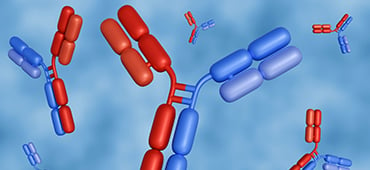
Duration: 3min

Eric Gong, Ph.D.
Senior Scientist
Dr. Eric Gong earned his Ph.D. in Structural Biology from the University of
Science and Technology of China and has worked at Cornell University as a postdoctoral
researcher. His research primarily focuses on the structure and biochemistry of nucleosomal
epigenetics. Dr. Gong has published his work in prestigious journals, including the Journal
of the American Chemical Society, Chemical Science, and Chemical Communications.
Bispecific antibodies (bsAbs) represent a groundbreaking class of antibodies capable of
recognizing and binding to two different antigens simultaneously. This unique characteristic gives
them extensive potential applications in the medical field, particularly in the treatment of cancer
and autoimmune diseases [1]. Unlike traditional monospecific antibodies, which can target
only a
single antigen due to having one antigen-binding region, bispecific antibodies can concurrently
target two distinct molecules through two separate antigen-binding regions (Figure 1). This
dual-targeting capability enhances the precision and efficacy of treatments. For instance, certain
bispecific antibodies can bind to both tumor cells and immune cells simultaneously, aiding the
immune system in attacking cancer cells more effectively. Leveraging this mechanism, bispecific
antibodies offer a more flexible and efficient approach to treating complex diseases.
Preventing Chain Mispairing: Preventing chain mispairing is a crucial challenge in the
development of bsAbs. Here are some commonly used strategies to address mispairing:

Figure 1 Schematic Diagram of Monospecific and Bispecific Antibodies
Knobs-into-Holes (KIH) design
- Overview: This strategy involves introducing "knob" and "hole" mutations to promote correct
heavy chain-heavy chain pairing (Figure 2) [2].
- Specific Mutations: Implement a "knob" mutation, such as T366W, at the interface of one heavy
chain, and a corresponding "hole" mutation, such as T366S or L368A, at the same position on the
other heavy chain (Figure 2).
- Advantages: By leveraging the steric effects of the protein structure, this design improves the
specificity and efficiency of chain pairing, thereby reducing the likelihood of mispairing.
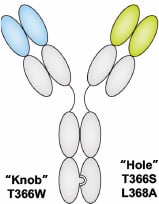
Figure 2 Schematic Diagram of “Knob into Hole”
CrossMab design
- Overview: This method promotes correct pairing by exchanging parts of the structure of the
antibody light chain or heavy chain (Figure 3) [3].
- Application: Suitable for various types of bi-specific antibody designs.
- Advantages: Reduces chain mispairing while preserving antibody function.
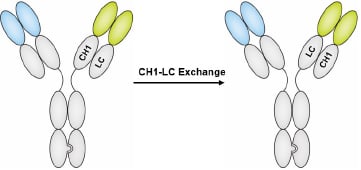
Figure 3 Schematic Diagram of CrossMab
Covalent Linkage
- Overview: Utilize covalent bonds to connect heavy and light chains, ensuring specific pairing.
- Specific methods: Introduce disulfide bonds or other covalent linking techniques.
- Advantages: Reduces chain dissociation and recombination, ensuring the structural stability of
antibodies.
scFv-Fc design
- Overview: Employ single-chain variable fragments (scFv) to connect Fc regions, forming
bispecific antibodies (Figure 4) [4].
- Application: By linking two scFv fragments to a single Fc region, a bispecific binding site is
created.
- Advantages: Reduces chain mispairing and enhances the specificity and stability of antibodies.
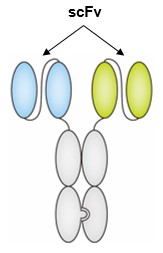
Figure 4 Schematic Diagram of scFv-Fc
Dual Variable Domain Immunoglobulin (DVD-Ig) Design
- Overview: two variable regions are linked in series, each with distinct specificity (Figure 5)
[5].
- Application: Ideal for bispecific antibodies that need to simultaneously target two different
antigens.
- Advantages: Ensures specific pairing and functionality through structural design.
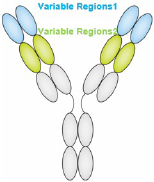
Figure 5 Schematic Diagram of DVS-Ig Structure
Quadroma technology
- Overview: Utilize two different hybridoma cells to fuse and produce bispecific antibodies
[6].
- Application: Form bispecific antibodies through the correct combination of four heavy chains and light
chains.
- Advantages: Naturally selects for correct chain pairing, reducing the chance of mispairing.
Common Light Chain Design
- Overview: Use the same light chain to pair with different heavy chains, ensuring specific
pairing (Figure 6).
- Application: Suitable for the design and production of bispecific antibodies.
- Advantages: Reduces mispairing and improves production efficiency and purification outcomes.

Figure 6 Design Schematic of Common Light Chain
These strategies significantly reduce chain mismatches in bispecific antibodies,
enhancing product purity and functionality by optimizing the structural design and production processes.
Combining these approaches with current purification techniques such as affinity chromatography, ion
exchange chromatography, and size exclusion chromatography can further optimize the production and
purification of bispecific antibodies.
With more than 19 years of experience in protein expression, GenScript has developed a
unique TurboCHO™ expression platform that efficiently
expresses recombinant antibodies and proteins.
Compared with conventional transient expression, the TurboCHO™ expression platform achieves higher yields of
recombinant proteins and antibodies. This platform provides an economical and efficient way to produce
secreted proteins and antibodies, helping customers complete functional, structural, and therapeutic studies
in a short period of time. Additionally, GenScript offers a HEK 293 cell expression system for selection.
References
[1] Labrijn AF, Janmaat ML, Reichert JM, Parren PWHI. Bispecific antibodies: a mechanistic
review of the pipeline. Nat Rev Drug Discov. 2019 Aug;18(8):585-608. doi: 10.1038/s41573-019-0028-1.
[2] Ridgway JB, Presta LG, Carter P. 'Knobs-into-holes' engineering of antibody CH3 domains for
heavy chain heterodimerization. Protein Eng. 1996 Jul;9(7):617-21. doi: 10.1093/protein/9.7.617.
[3] Klein C, Schaefer W, Regula JT. The use of CrossMAb technology for the generation of bi-
and multispecific antibodies. MAbs. 2016 Aug-Sep;8(6):1010-20. doi: 10.1080/19420862.2016.
[4] Kontermann RE, Brinkmann U. Bispecific antibodies. Drug Discov Today. 2015
Jul;20(7):838-47. doi: 10.1016/j.drudis.2015.02.008. Epub 2015 Feb 26. Erratum in: Drug Discov Today. 2019
Jul;24(7):1422. doi: 10.1016/j.drudis.2017.12.004.
[5] DiGiammarino E, Ghayur T, Liu J. Design and generation of DVD-Ig™ molecules for
dual-specific targeting. Methods Mol Biol. 2012;899:145-56. doi: 10.1007/978-1-61779-921-1_9.
[6] Chelius D, Ruf P, Gruber P, Plöscher M, Liedtke R, Gansberger E, Hess J, Wasiliu M,
Lindhofer H. Structural and functional characterization of the trifunctional antibody catumaxomab. MAbs.
2010 May-Jun;2(3):309-19. doi: 10.4161/mabs.2.3.11791.


 Most Popular Reagents
 Instruments
 Antibodies
 Protein Electrophoresis and Blotting
 Molecular Biology
 Stable Cell Lines
 Cell Isolation and Activation
 IVD Raw Materials
 Therapy Applications
 Resources