Duration: 6
min

Fei Wang, Ph.D.
Senior Scientist
Dr. Fei Wang graduated from Yangzhou University with a Ph.D. in Preventive
Veterinary Medicine. Fei has published his work in journals, including Emerging Microbes &
Infections and Microbiology Spectrum, and his dissertation was awarded as an Excellent
Doctoral Dissertation in Jiangsu Province. He joined GenScript's Antibody Department and has
been working as a Senior Scientist since 2022. Fei has over 8 years of experience in
antibody discovery and antibody-based assay development. He is currently responsible for the
polyclonal antibody platform and kit development platform. He has participated in the
delivery of over 100 anti-ID projects and 10 customized PK kit projects.
Introduction
Glucagon-like peptide-1 (GLP-1) is a kind of incretin hormone produced by the cleavage of proglucagon, mainly synthesized in the intestinal mucosal L-cells, pancreatic islet α-cells, and neurons in the nucleus of the solitary tract. GLP-1 regulates blood glucose levels and lipid metabolism by binding with GLP-1 receptors which result in increased insulin secretion, decreased glucagon release, delay of gastric emptying, and less food intaking through central appetite suppression. GLP-1 receptor agonist (GLP-1RA) pharmaceuticals pose significant therapeutic potency in diabetes1, cardiovascular disorders2, and neurodegenerative diseases3.
Proglucagon precursor is a peptide consists of 160 amino acids, which undergoes enzymatic processing and further evolve into GLP-1(1-37) and GLP-1(7-36) amide or GLP-1(7-37) peptide variants. Among the amino acid sites, His7, Gly10, Asp15, and Phe28 are the key sites that bind and activate GLP-1R. While the half-life of GLP-1 is only 2 mins because it will lose its biological efficacy after enzymatic digestion by the dipeptidyl peptidase IV(DPP-4). Therefore, it is a great challenge to extend the half-life of GLP-1RA pharmaceuticals.
Different forms of GLP-1RA pharmaceuticals
Vaccines based on anti-ID antibodies
Exenatide shares 53% homology with human GLP-1 sequence. The second amino acid at position 8 is glycine instead of alanine, which cannot be easily cleaved by the DPP-4. Moreover, it also contains PSSGAPPPS sequence at C-terminal, which cannot be easily degraded by peptide chain endonucleases. These changes contribute to a 2h half-life and strong biological activity of exenatide.
Liraglutide shares 97% homology with human GLP-1 sequence. Liraglutide has an arginine at position 34 instead of lysine, and the lysine at position 26 is replaced by glutamic acid modified with a 16-carbon palmitic acid side chain. The half-life of liraglutide is 13h. PEGylated liraglutide has the PEG modified cysteine which takes place of C-terminal serine, which contributes to a half-life of 1 week.
Lixisenatide is designed based on the exenatide, while it lacks proline at position 38, and 6 lysines are linked after serine at position 39. These changes not only prevent the degradation, but also lead to increased rigidity of the peptide structure and enhanced biological activity. The half-life of lixisenatide is approximately 3–4h.
Albiglutide contains an arginine at position 8 instead of lysine, and further fuses to human serum albumin (HSA) to enhances proteolytic stability. The half-life of albiglutide is approximately 5 days.
Dulaglutide shares 90% homology with human GLP-1 sequence. It has glycine at position 8, glutamic acid at position 22, and glycine at position 36. It is further fused to the Fc of human IgG4 via a (G4S )3 linker. The half-life of dulaglutide is approximately 4.5 days.
Semaglutide contains diaminoisobutyric acid at position 8, acylated lysine at position 26, and arginine at position 34. It also has a longer aliphatic chain and increased hydrophobicity, but its hydrophilicity is greatly enhanced by PEG modification. The half-life of semaglutide is approximately 7 days. Semaglutide co-formulated with the absorption enhancer sodium N-[8 (2-hydroxylbenzoyl) amino] caprylate (SNAC) is the first oral GLP-1 analog. SNAC causes a localized increase of pH in stomach, leading to protection against proteolytic degradation and transcellular absorption.
Beinaglutide, a natural human GLP-1(7-36)-NH2 expressed in Escherichia coli. The half-life of beinaglutide is approximately 11 mins.
Tirzepatide is a dual agonist dual agonist for both GLP-1R and gastric inhibitory polypeptide receptor (GIPR). It has a peptide backbone of 39 amino acids and a 20-carbon palmitic acid side chain at position 26. The amino acids at positions 8 and 19 in tirzepatide are amino isobutyric acid. The half-life of tirzepatide is approximately 5 days.
Retatrutide is a novel triple agonist that activates GLP-1R, GIPR and G protein-coupled receptor (GCGR). The peptide backbone sequence originates from GIP peptide, and amino acids at position 8,19 and 21 are unnatural amino acids. In addition, this peptide also has a C20 fatty acid dicarboxylic acid moiety conjugation through the linker of the lysine residue at position 23.
Orforglipron, Danuglipron and GSBR-1290 are oral small molecule GLP-1RAs4.
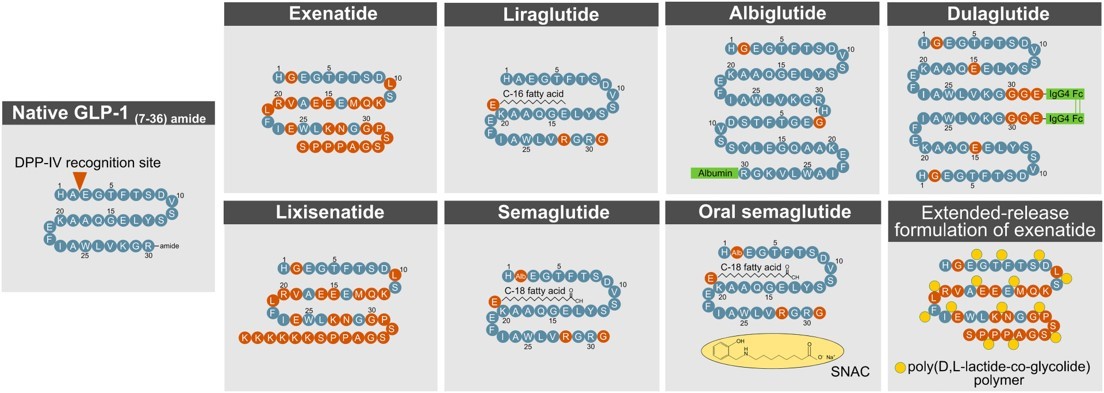
Different forms of GLP-1RA pharmaceuticals5
Different approaches for generating ADA against GLP-1RA pharmaceuticals
Although pAb and mAb discoveries are simple and mature technologies. The ADA development strategies for GLP-1RA may also vary due to the diverse forms of GLP-1RA pharmaceuticals. There are following points need to be considered during ADA generation.
Conjugation and immunization
GLP-1RA pharmaceuticals as exenatide, liraglutide, lixisenatide, semaglutide and small-molecule ones all need to be conjugated to carrier protein as KLH for immunization. Sulfhydryl, amino and carboxyl groups are the most-used sites for peptide conjugation. While some of GLP-1RA pharmaceuticals are linked with fatty acid or PEG, it is a challenge to activate these peptides for conjugation with carrier protein. Especially for some of novel GLP-1RA pharmaceuticals, which is very novel and the structure and sequences are not disclosed to antibody developers. Some of GLP-1RAs are fused or conjugated with human albumin or Fc of human IgG. The molecular weight of these pharmaceuticals is high enough to act as potent immunogen in inducing B cells to produce antibodies. Therefore, these GLP-1RA pharmaceuticals do not need to be conjugated to carrier protein.
Although the final product of pharmaceutical is the best choice as immunogen in ADA development, some pharmaceutical adjunct as SNAC may pose negative impacts on conjugation with carrier protein and immunogen emulsification. In these cases, only GLP-1RA part should be used for conjugation and immunization. Normal dosage and immunization frequency is suitable for the ADA development, but the health status of animals needs to be closely monitored. For example, potential animal emaciation caused by activation of GLP-1R.
Due to the poor immunogenicity and high homology of most GLP-1RA pharmaceuticals, express immunization is not recommended for ADA development. Even in conventional immunization, some GLP-1RA pharmaceuticals need 4 to 5 immunizations to induce good responses.
Interferences in detection and screening
Indirect ELISA is the most-used assay to monitor the serum titer of animal and quality of purified antibody. Most of GLP-1RAs can be directly coated onto ELISA plates, while small-molecule ones and some of modified peptides may cannot be absorbed to the surface of the plate well. In these cases, conjugation to another carrier protein (OVA or BSA) or labeling by biotin can be chosen to help the GLP-1RAs bind to the plate or streptavidin coated plates. However, it should be noted that if there is linker between GLP-1RA and carrier protein or biotin, attention should be paid to antibodies against linkers. To albiglutide and dulaglutide, additional test on the albumin or Fc is very necessary, because only very small part of antibodies induced in serum are specific to the GLP-1RA and there may be no significant signal differences on GLP-RA and counter-screening material.
Similarly, some final product of GLP-1RA pharmaceuticals cannot be used for the ELISA test due to interfering excipients in the formulation. Moreover, especially for PEGylated GLP-1RA pharmaceuticals, it would be better to test any interference caused by the tween in the first serum titer detection.
Prosper purification
Purity of ADA would affect the accuracy of quantitative detection assays. Therefore, sequential purification is required for ADA production. The first step for anti-GLP-1RA pharmaceutical pAb purification should be protein A/G affinity chromatography. Then eluted antibody should be incubated with the resin conjugated with GLP-1RA pharmaceuticals to enrich the specific antibodies. For albiglutide and dulaglutide, the eluted specific antibodies should be further incubated with albumin conjugated resin or Fc conjugated resin to remove the antibodies that induced by albumin or Fc protein. As same as in immunogen preparation, it is a challenge to conjugate GLP-1RA pharmaceuticals to the resin due to confidential structures. In view of multiple steps of purifications involved in ADA generation, magnetic beads and other rigid resins are not recommended because of potential physical damage to antibodies.
Some of antibody developer may prefer to do protein A/G affinity chromatography after antigen affinity purification, because it will result in much less cost of protein A resin compared to directly purify total IgG from pooled serum. But the flaw is that some of residual non-specific binding proteins and IgGs coming from the antigen affinity purification may be very hard to remove by further protein A/G purification. In that case, additional complicated purification as size exclusion chromatography - high performance liquid chromatography (SEC-HPLC) will be required, which will ulteriorly result in antibody losses and lower ADA yield.
GenScript ADA generation service is as fast as 7 weeks
GenScript ADA development service covers diverse types of antigens, including antibody drugs, GCT drugs, peptide drugs, protein drugs, vaccines, oligonucleotide drugs, and small molecule drugs. The shortest turnaround time for rabbit ADA polyclonal development is 7 weeks, the shortest turnaround time for Anti-ID rabbit monoclonal antibody development is 9 weeks. What’s more, our rabbit anti-ID mAb service is now the same price as our mouse anti-ID mAb. Now you can take advantage of premier rabbit anti-ID mAb development for the price of mouse!
References
[1] Meier JJ. GLP-1 receptor agonists for individualized treatment of type 2 diabetes mellitus. Nat Rev Endocrinol. 2012 Dec;8(12):728-42.
[2] Pandey S, Mangmool S, Parichatikanond W. Multifaceted Roles of GLP-1 and Its Analogs: A Review on Molecular Mechanisms with a Cardiotherapeutic Perspective. Pharmaceuticals (Basel). 2023 Jun 3;16(6):836.
[3] Kalinderi K, Papaliagkas V, Fidani L. GLP-1 Receptor Agonists: A New Treatment in Parkinson's Disease. Int J Mol Sci. 2024 Mar 29;25(7):3812.
[4] Zheng Z, Zong Y, Ma Y, Tian Y, Pang Y, Zhang C, Gao J. Glucagon-like peptide-1 receptor: mechanisms and advances in therapy. Signal Transduct Target Ther. 2024 Sep 18;9(1):234.
[5] Tan Q, Akindehin SE, Orsso CE, Waldner RC, DiMarchi RD, Müller TD, Haqq AM. Recent Advances in Incretin-Based Pharmacotherapies for the Treatment of Obesity and Diabetes. Front Endocrinol (Lausanne). 2022 Mar 1;13:838410.


 Most Popular Reagents
 Instruments
 Antibodies
 Protein Electrophoresis and Blotting
 Molecular Biology
 Stable Cell Lines
 Cell Isolation and Activation
 IVD Raw Materials
 Therapy Applications
 Resources