Duration: 8
min

Chuanxin Liu, Ph.D
Dr. Chuanxin Liu earned his PhD in Biochemistry and has over a decade of extensive
experience in immunology and virology. Since joining GenScript in 2020, he has been responsible
for cell engineering, cell-based assays, and viral vectors for biologics characterization.
Currently, he serves as a Senior Scientist in the R&D team, specializing in the advanced
development of viral vector production.
Biological Origin of Lentivirus
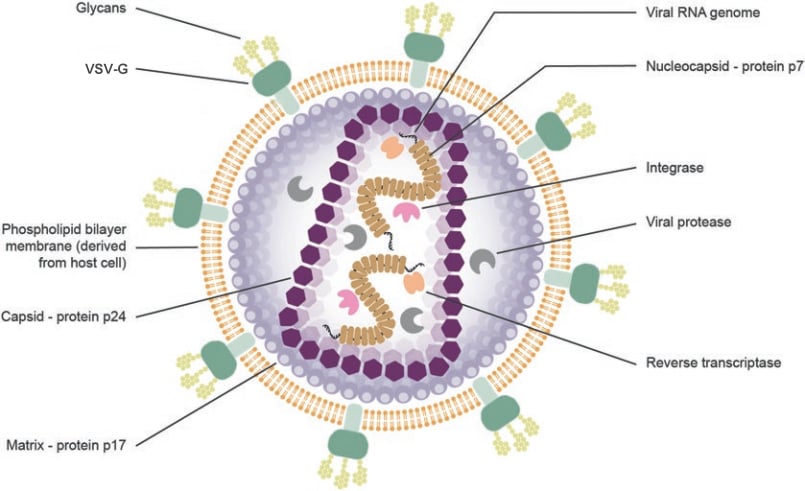
Lentiviral vectors are highly efficient gene delivery tools derived from type 1 human immunodeficiency virus (HIV-1). The core genome of lentiviruses is made up of single-stranded RNA. Through genetic engineering, regulatory and auxiliary genes necessary required for viral replication are removed, and heterologous elements are introduced to create a replication-deficient recombinant vector system.
Structurally, mature lentivirus particles consist of three key components:
- Lipid Bilayer Envelope: The surface of the vector is engineered to display a modified envelope glycoprotein, (e.g., VSV-G), which can recognize broadly expressed receptors on the surface of host cells (e.g., low-density lipoprotein receptors). This modification circumvents the host cell specificity imposed by the native HIV Env protein (which targets CD4+ cells), allowing the vector to infect a broader range of cell types while maintaining stable infectivity.
- Viral Core: The core is composed of Gag structural proteins (p24, p17, p7) and Pol functional enzymes (reverse transcriptase, integrase, protease). The capsid protein (p24) encapsulates the RNA genome and essential enzymes to facilitate efficient transcription and integration. The matrix protein (p17) contains a nuclear localization signal (NLS) that directs the preintegration complex to the nucleus of infected cells. The nucleocapsid protein (p7), binding to genomic RNA, is indispensable for viral assembly and release.
- Genome: The genome consists of long terminal repeats (LTRs) at both ends, which encompass the packaging signal (ψ), Rev response element (RRE), central polypurine tract/central termination sequence (cPPT/CTS), and the Woodchuck hepatitis virus post-transcriptional regulatory element (WPRE). The expression cassette for the exogenous gene is driven by an internal promoter, enabling stable integration and long-term expression.
Core Advantages of Lentiviral Vectors
- Broad Spectrum of Cell Infection: Lentiviral vectors possesses unique biological characteristics that enables them to penetrate the nuclear membrane of non-dividing cells, As a result, they can effectively transduce both dividing and non-dividing cells (such as neurons and stem cells), overcoming the limitations of traditional vectors.
- Stable Long-term Expression:Upon integration into the host genome, exogenous genes delivered by lentiviral vectors can achieve stable and sustained expression. This makes them suitable for applications requiring long-term therapeutic effects, such as in genetic disorders and chronic diseases.
- High Cargo Capacity: Lentiviral vectors can accommodate up to 6.5 kb of exogenous genetic material, supporting complex genetic regulatory elements and multi-gene co-delivery strategies.
- Low Immunogenicity: Compared to adenoviral vectors and other delivery systems, lentiviral vectors exhibit lower immunogenicity, resulting in a reduced host immune response and improved therapeutic safety.
Owing to these unique advantages, lentiviral vectors hold great promise across a wide range of applications including gene therapy, cell therapy, vaccine development, and functional genomics research.
Table: Comparison of Commonly Used Viral Vectors
| Characteristics |
Lentivirus |
AAV |
Adenovirus |
| Size |
~80-100 nm |
~25 nm |
~90-100 nm |
| Viral genome |
ssRNA |
ssDNA |
dsDNA |
| Packaging capacity |
9 kb |
4.7 kb |
up to 36 kb |
| Transduction |
Dividing and non-dividing cells |
Dividing and non-dividing cells |
Dividing and non-dividing cells |
| Transduction efficiency |
Moderate |
Moderate |
High |
| Integration |
Integrating |
Non-integrating |
Non-integrating |
| Expression |
Stable |
Transient, or stable in non-dividing cells |
Transient |
| Biosafety level |
BSL-2 |
BSL-1 |
BSL-2 |
| Advantage |
Highly customizable
Integrating into the host genome |
High safety
In vivo application
|
Large capacity |
| Challenging |
Slight risk of insertional mutagenesis In vivo application |
Low capacity
Off-target Pre-existing immunity
|
High immunogenicity
Off-target Pre-existing immunity
|
Technological Evolution of Lentiviral Vectors
The development of lentiviral vector systems has progressed through three major generations, each significantly improving both safety and functionality.
- First Generation: Based on early modifications of the HIV-1 virus, this system retains all HIV genes except for the env gene, including gag, pol, tat, rev, and accessory genes (vif, vpr, vpu, and nef). A three-plasmid system (packaging plasmid, envelope plasmid, and transfer plasmid) is used for virus packaging. The env gene is replaced with VSV-G protein to achieve broad-spectrum infectivity via interaction with LDL receptors. While the separation of essential genes reduces the risk of recombination, the presence of auxiliary genes may still present immunogenicity or oncogenic risks.
- Second Generation: Building on the first generation, this version removes four auxiliary genes (vif, vpr, vpu, nef), retaining only core genes (gag, pol) and regulatory genes (tat, rev). The 5′ LTR in the transfer plasmid still depends on activation by the Tat protein, requiring a compatible second-generation packaging system. While this generation offers improved safety over the first, its reliance on Tat poses potential risks of transcriptional dysregulation. It remains widely used in laboratory research, particularly for efficient gene delivery using plasmids such as pSPAX2 and pMD2.G.
- Third Generation: This system further enhances safety by completely separating the viral functional components into a four-plasmid system: gag/pol plasmid, rev plasmid, VSV-G envelope plasmid, transfer plasmid. It eliminates Tat protein dependency by replacing the 5'LTR U3 region with a heterologous promoter (such as CMV or RSV). Additionally, it introduces a self-inactivating (SIN) design, abolishing the promoter activity in the 3'LTR region to prevent transcription initiation after integration. Although the four-plasmid system is more complex to transfect, it significantly reduces the risk of generating replication-competent lentivirus (RCL), making it the preferred platform for clinical applications such as CAR-T cell therapy and gene therapy.

Lentiviral Vector Production Systems
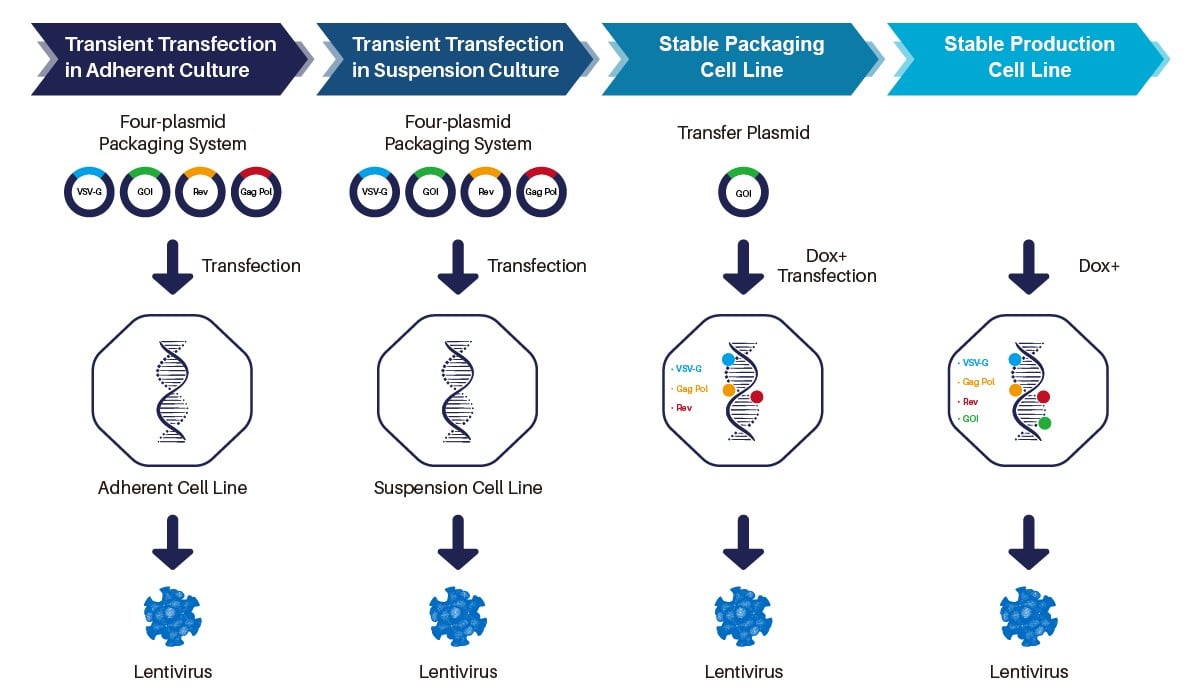
Lentivirus packaging technology can be classified into four main types, each with distinct technical characteristics and application scenarios:
- Transient Transfection in Adherent Culture: This system utilizes adherent HEK293T cells, transfected with multiple plasmids (typically 4: target gene plasmid + gag-pol packaging plasmid + VSV-G envelope plasmid + rev auxiliary plasmid) using chemical reagents like PEI. Core advantages include high maturity and operational flexibility, suitable for small-scale laboratory preparation. Challenges include reliance on serum-based media, difficulty scaling up (requiring multilayer cell factories), significant batch variation, and high plasmid cost. Applicable to early research or small dose virus preparations (e.g., CAR-T cell modification for research).
- Transient Transfection in Suspension Culture: This system employs suspension-adapted HEK293 cells in serum-free media for virus production via transient transfection (e.g., four-plasmid system). Core advantages include easy scale-up (reactor scale up to 500L), reduced contamination risk due to closed operations, and lower costs compared to adherent systems. Challenges include persistent high transfection costs. Suitable from early research to clinical and commercial production needs.
- Stable Packaging Cell Line: This system stably integrates viral packaging elements (Gag/Pol, Rev, VSV-G) into the host genome, requiring only the transfection of the target gene plasmid, followed by activation by inducer (e.g., tetracycline) to initiate production. Core advantages include reducing plasmid usage by 75% and high process stability (batch variation <10%), with serum-free suspension culture supporting industrial-scale expansion. Challenges include the need to screen stably integrated cell lines and longer development cycles; the target gene still requires plasmid transfection, maintaining some plasmid dependency. Applicable for large-scale continuous production (e.g., GMP-grade viral vectors for gene therapy).
- Stable Production Cell Line: This system pre-integrates all components (including target genes) into the host genome, activated by inducers (e.g., tetracycline) to initiate virus assembly, entirely eliminating plasmid dependency. Core advantages include 80%+ reduction in plasmid cost, excellent process stability (automated control), and reduced production cycles by 30%-50%. Challenges include complex cell line development, high inducer costs, and stringent process parameter controls. Suitable for industrial-scale continuous production (extremely large-scale demands).
GenScript Lentiviral Packaging Services – Dual Assurance of Quality and Speed
Leveraging the third-generation self-inactivating (SIN) lentiviral system, GenScript offers a one-stop lentivirus packaging solution from vector design, gene synthesis to virus packaging and purification, accelerating your gene therapy research. Our core advantages include:
- High Titer Delivery: Utilizing advanced serum-free suspension culture technology and optimized proprietary GLV3 vector, we gurantee the delivery of lentivirus with titer higher than 10⁸ TU/mL, ensuring highly efficient cell infection for more significant experimental outcomes.
- Rapid Turnaround Time: Virus packaging can be completed in as fast as 5 business days, with the entire process from gene synthesis to virus packaging achievable within just 10 business days.
- Rigorous Quality Control: To guarantee premium-quality delivery, we provide a full range of quality control tests, including p24 ELISA, duplex qPCR, FACS, mycoplasma testing, and sterility testing.
Interested in learning more about GenScript Lentivirus Packaing Service? Click the button below to learn more and get in touch with us — we’re here to help!
References
[1] Schito, M., Soloff, A., Slovitz, D., Trichel, A., Inman, J., Appella, E., ... & Barratt-Boyes, S. (2006). Preclinical evaluation of a zinc finger inhibitor targeting lentivirus nucleocapsid protein in SIV-infected monkeys. Current HIV Research, 4(3), 379-386.
[2] Nóbrega, C., Mendonça, L., Matos, C.A. (2020). Viral Vectors for Gene Therapy. In: A Handbook of Gene and Cell Therapy. Springer, Cham.
[3] University of Vermont Risk Management and Safety. (2023). Lentiviral vectors fact sheet.
[4] Smith, J., & BioInsights. (2022). Addressing the challenges of commercial-scale manufacture of viral vectors for CAR-T therapies. Cell & Gene Therapy Insights, 8(5).
[5] Klimpel, M., Terrao, M., Bräuer, M., Dersch, H., Biserni, M., Melo Do Nascimento, L., ... & Laux, H. (2024). Generation of stable suspension producer cell lines for serum‐free lentivirus production. Biotechnology Journal, 19(5), 2400090.
[6] Dawson, L., & Yu, X. F. (1998). The role of nucleocapsid of HIV-1 in virus assembly. Virology, 251(1), 141-157.
[7] Schito, M. L., Soloff, A. C., Slovitz, D., Trichel, A., Inman, J. K., Appella, E., ... & Barratt-Boyes, S. M. (2006). Preclinical evaluation of a zinc finger inhibitor targeting lentivirus nucleocapsid protein in SIV-infected monkeys. Current HIV research, 4(3), 379-386.
[8] Matthews, S., Barlow, P., Boyd, J., Barton, G., Russell, R., Mills, H., ... & Campbell, I. (1994). Structural similarity between the p17 matrix protein of HIV-1 and interferon-γ. Nature, 370(6491), 666-668.


 Most Popular Reagents
 Instruments
 Antibodies
 Protein Electrophoresis and Blotting
 Molecular Biology
 Stable Cell Lines
 Cell Isolation and Activation
 IVD Raw Materials
 Therapy Applications
 Resources