



































5 BDs
to Lentivirus Packaging
10 BDs from gene to lentivirus
1E+8 TU/mL
Guaranteed Functional Titer
Average delivered titer 3 times higher than guaranteed
>10Kb Large Insert
Maximum 400% Titer Boost
Proprietary lentivirus platform for large insert with unmatched efficiency
100% Accuracy
Functional Titer
Exclusive Default QC - Duplex qPCR
| Scale | Application | Guaranteed Functional Titer ⓘ |
Volume | TAT | Default QC | Deliverable |
|---|---|---|---|---|---|---|
| Purified | Cell Culture | >1E+8 TU/mL | 0.1 mL 1 mL 5 mL |
Starting at 7 business days |
|
|
| >1E+9 TU/mL | 1mL | |||||
| Supernatant | >2E+6 TU/mL | 0.2 mL | Starting at 5 business days |
|
|
|
| Ultra-purified | In Vivo Animal Study | >1E+8 TU/mL | 1 mL 2 mL 5 mL 10 mL |
Starting at 12 business days |
|
|
| >1E+9 TU/mL | 0.5 mL 1 mL |
Note:
P24 ELISA: Quantify capsid proteins, measures the total number of viral particles (physical
titer). The calculated functional titer (TU/mL) is derived from the P24 titer equation and represents a
predicted value, which may differ from actual functional titers.
Duplex qPCR: Directly measure and quantify the infectious viral particles capable of
transducing target cells, providing precise functional titer.
| # | Vector Name | Application | Promoter | Antibiotics Marker | Fluorescence Marker |
|---|
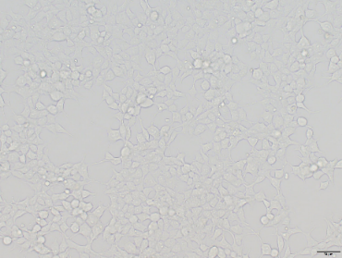
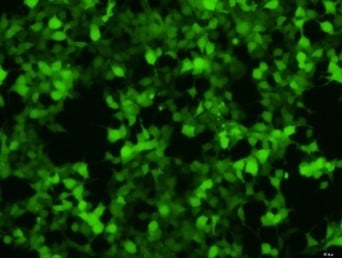
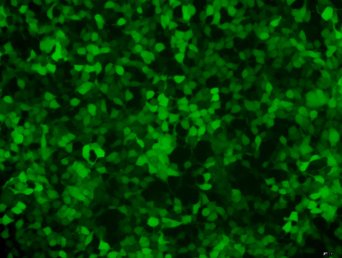
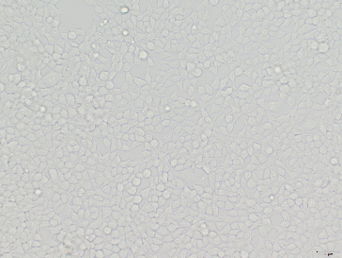
| Bright Field | Fluorescence Field | |
![]() |
![]() |
Positive control MOI = 2 (by qPCR titration) |
![]() |
![]() |
Sample 1 LTR Insert Length: >9 kb Duplex qPCR Titer: 2.52×10^8 TU/mL MOI = 1.5 (by qPCR titration) |
![]() |
![]() |
Sample 2 - 1μL LTR Insert Length: >9 kb Duplex qPCR Titer: 2.06×10^8 TU/mL MOI = 1.5 (by qPCR titration) |
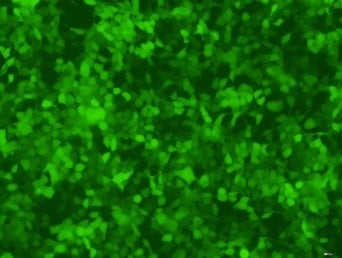
Challenge: Primary cells are difficult to transduce due to their non-dividing nature. And the downstream application (CAR-T therapy) required high transduction efficiency at a low MOI.
Solution: Built on our proprietary lentiviral packaging system and pGS-LVV vector, we optimized the transfection workflow with production boosters to deliver lentiviral vector with high functional titer.
Lentiviral Vector: pGS-LVV-EF1a-CD19CAR-T2A-EGFP
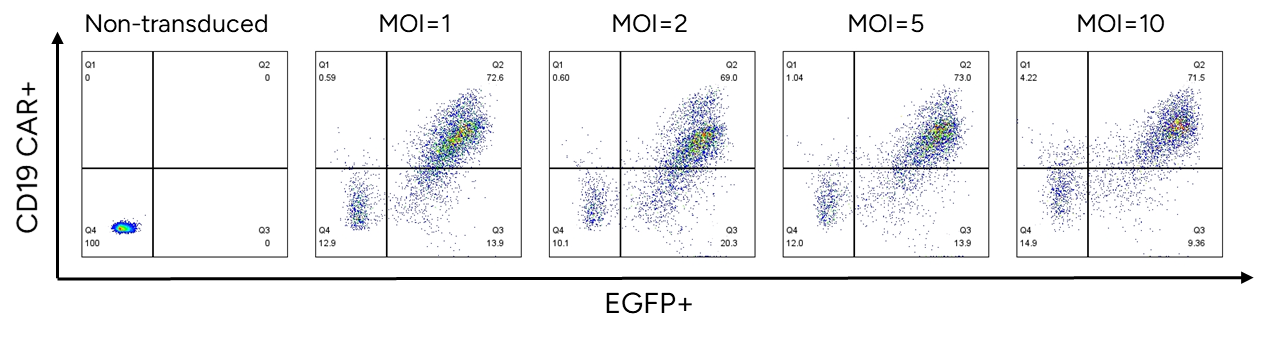
Result: Delivered lentiviral vector with a functional titer of 7.07×10⁹ TU/mL (duplex qPCR). The lentiviral vector successfully mediated anti-CD19 CAR expression in primary human PBMCs. Even at a low MOI of 1, transduction efficiency exceeded 70%.
| Human PBMC | Positive Cells (%) EGFP+/CD19CAR+ |
|---|---|
| Non-transduced | 0.0% |
| MOI=1 | 72.6% |
| MOI=2 | 69.0% |
| MOI=5 | 73.0% |
| MOI=10 | 71.5% |
Challenge: The oversized insert (>10 kb) compromises lentiviral packaging efficiency, resulting in low viral titer and poor downstream performance.
Solution: Utilizing our proprietary lentivirus packaging system, we optimized each step of virus packaging specialized for large
insert
(>6.5 kb) to achieve high-titer delivery.
Result:
| Bright Field | Fluorescence Field | |
![]() |
![]() |
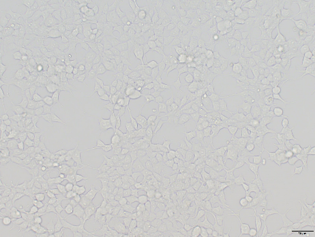
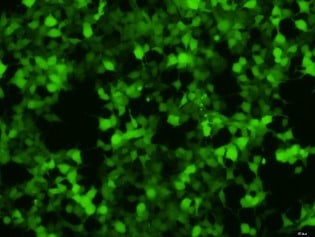
Positive Control 5’ LTR to 3’ LTR: 6,570 bp MOI = 2 (by qPCR titration) Time: 48h after transduction |
![]() |
![]() |
Sample 1 5’ LTR to 3’ LTR: 11,288 bp Duplex qPCR Titer: 1.03×10^8 TU/mL MOI = 2 (by qPCR titration) Time: 48h after transduction |
Challenge: The requirement for co-delivering Cas9 and gRNA resulted in a large insert size, compromising lentiviral packaging efficiency. Additionally, the inherent resistance of macrophages to transduction, driven by their robust antiviral mechanisms, required lentivirus with high functional titers.
Solution: Utilizing our proprietary lentivirus packaging system, we optimized each step of virus packaging specialized for large insert(> 6.5kb) to achieve high-titer delivery.
Result: Delivered Cas9+gRNA lentivirus with a functional titer >1×10⁹ TU/mL, successfully establishing stable cell pools with >90% gene knockout efficiency.
Validation of Knockout Efficiency by Western Blot
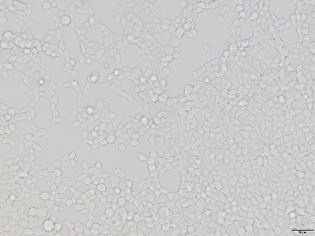
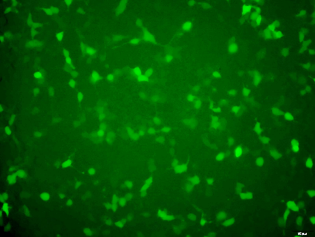
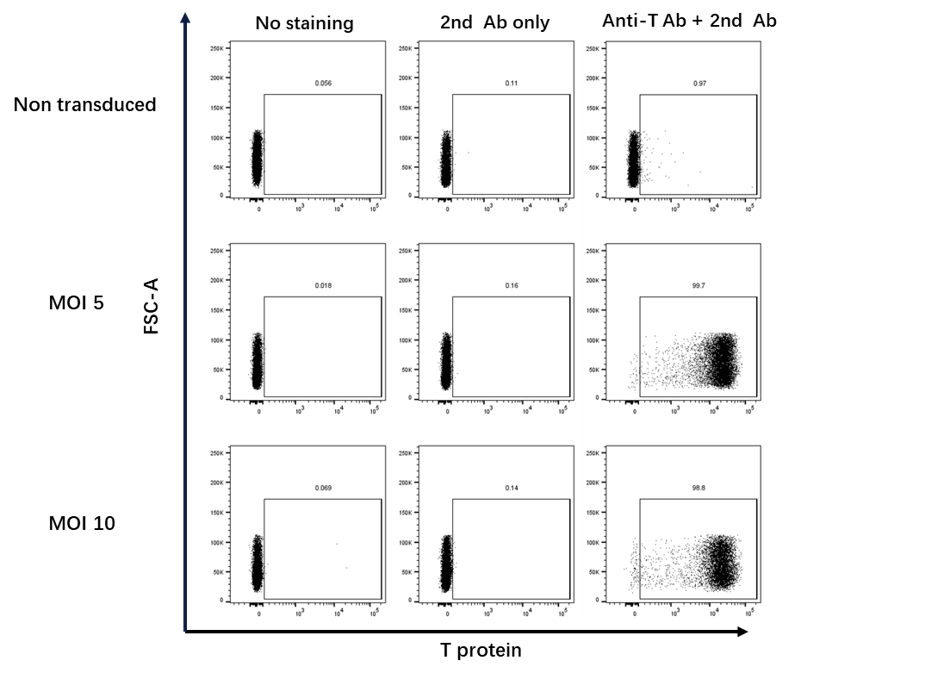
Background: Multi-transmembrane proteins are challenging to express on the cell surface due to complex folding and membrane integration.
Strategy: Using lentiviral packaging of pGS-LVV-CAG-T-hPGK-PuroR, HEK293T cells were efficiently transduced at MOI 5 and 10.
Results: This approach achieved 100% positive expression of the T (12-transmembrane) protein, with levels exceeding 100-fold above baseline without enrichment, demonstrating that viral delivery enables high-efficiency transduction and robust expression of difficult multi-transmembrane targets.
Ultra-purified LVVs achieved successful systemic delivery and sustained transgene expression for at least 7 days in mice, demonstrating potential for in vivo gene delivery applications.

In vivo expression of VSV-G-pseudotyped LVVs in BALB/c mice. In vivo-grade lentiviral vectors expressing firefly luciferase (Fluc) were administered to BALB/c mice by intravenous (IV) injection at doses of 2.0 × 10^7 TU or 5.0 × 10^7 TU per mouse. Fluc expression was monitored by whole-body bioluminescence imaging using an IVIS imaging system.
(A) Quantification of Fluc expression at 24, 72, and 168 hours post-injection.
(B) Representative IVIS images showing the distribution and intensity of Fluc expression in BALB/c mice.