Duration: 3 min

Eric Gong, Ph.D.
Senior Scientist
Dr. Eric Gong earned his Ph.D. in Structural Biology from the University of Science and Technology of China and has worked at Cornell University as a postdoctoral researcher. His research primarily focuses on the structure and biochemistry of nucleosomal epigenetics. Dr. Gong has published his work in prestigious journals, including the Journal of the American Chemical Society, Chemical Science, and Chemical Communications.
Introduction
Antibodies play a crucial role in the field of biomedicine as an important component of the
immune system [1]. Their unique
structure and diverse functions make them indispensable tools in the
treatment and prevention of diseases.
Basic structure of antibody
The antibody is composed of two heavy chains and two light chains, which are connected
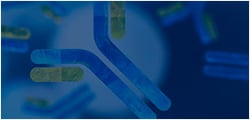
by disulfide bonds to form a Y-shaped molecular structure (Figure 1). At the end of each antibody
molecule, there is a highly variable region called the antigen-binding site (paratope), which
determines the antibody's ability to bind specifically to a particular antigen [2].
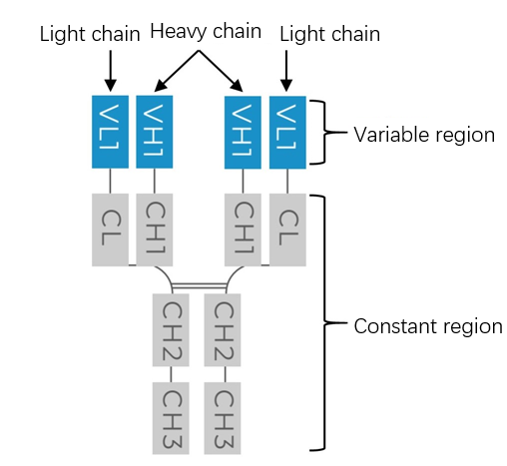
Figure 1 Antibody structure diagram
The function and mechanism of antibodies
Antibodies play various important roles in the immune response. The main functions include:
a. Antigen binding and recognition: Antibodies bind specific antigen molecules, such as surface
proteins on pathogens, through their variable regions.
b. Neutralization and clearance: Antibodies can neutralize the virulence of pathogens or
prevent their invasion of host cells.
c. Activation of immune response: Antibodies can also activate various immune responses by
binding to receptors on immune cells, including cytotoxic effects and pro-inflammatory responses.
The structural diversity and engineering of antibodies
The variable regions of antibodies exhibit great diversity, which enables antibodies to adapt
to different antigen structures. Through genetic engineering techniques, scientists can alter the structure
and function of antibodies to enhance their therapeutic effects and reduce immunogenicity. For example, by
artificially synthesizing and modifying the variable regions of antibodies, higher binding affinity and
longer blood half-life can be achieved.
The application of antibodies in biomedicine
The application of antibodies in medical treatment is becoming increasingly widespread,
covering the treatment and prevention of a variety of diseases. Traditional monoclonal antibodies such as
Trastuzumab and Rituximab have been successfully used in the treatment of multiple cancers, inhibiting tumor
growth and spread by targeting tumor-specific antigens. At the same time, the emergence of bispecific
antibodies, such as Blinatumomab for leukemia treatment and Emicizumab for hemophilia treatment, provides
new strategies for the treatment of related diseases [3]. These antibodies can simultaneously bind to
different antigens or cell surface receptors, providing higher efficacy and precision in the treatment of
specific diseases.
Summary
Antibodies, as an important component of the immune system, have broad and diverse prospects
for application in the field of biomedicine. Future research and technological innovation will further
promote the development of antibody drugs, providing new treatment strategies and opportunities for human
health.
With over 19 years of protein expression experience, GenScript has developed the unique
TurboCHO™ expression platform, which can efficiently express recombinant antibodies and recombinant proteins
(Mammalian protein expression system – GenScript Compared to conventional transient expression, the
TurboCHO™ expression platform can achieve the desired levels of
recombinant proteins and antibodies with
higher yield. This platform has economically and efficiently produced secreted proteins and antibodies,
helping customers to successfully complete functional, structural, and therapeutic research in a short
period of time. In addition, GenScript also provides the HEK 293 cell expression system for selection.
References
[1] Labrijn AF, Janmaat ML, Reichert JM, Parren PWHI. Bispecific antibodies: a mechanistic
review of the pipeline. Nat Rev Drug Discov. 2019 Aug;18(8):585-608. doi: 10.1038/s41573-019-0028-1.
[2] Chiu ML, Gilliland GL. Engineering antibody therapeutics. Curr Opin Struct Biol. 2016
Jun;38:163-73. doi: 10.1016/j.sbi.2016.07.012.
[3] Szijj P, Chudasama V. The renaissance of chemically generated bispecific antibodies. Nat
Rev Chem. 2021 Feb;5(2):78-92. doi: 10.1038/s41570-020-00241-6.


 Most Popular Reagents
 Instruments
 Antibodies
 Protein Electrophoresis and Blotting
 Molecular Biology
 Stable Cell Lines
 Cell Isolation and Activation
 IVD Raw Materials
 Therapy Applications
 Resources