IVD Raw Materials
Resources » Technical Resource Centers » Antibody Drug Discovery Technical Resource » Lead Selection and Optimization
Lead selection refers to the process by which the early hits are interrogated in a vigorous, multi-step screening process to select lead molecules that meet pre-established criteria for progressing to the next stage. Screening via secondary and tertiary functional assays filters from hundreds of hits down to a few Ab molecules. These are then purified in milligram quantities for more detailed characterization1.
Lead characterization typically includes in vitro efficacy studies for confirmation of binding and functional activities as well as biochemical and biophysical analyses. Common molecular analysis includes determination of expression levels from mammalian expression systems, aggregation analysis by SEC, SDS-PAGE, Western blot analysis, determination of target protein binding affinity by Biacore and KinExA analysis, and crude epitope mapping1. Examples of in vitro studies include Fcγ, FcRn, C1q assays. Upon completion of in vitro characterization, selected hits are ready for expression and purification in sufficient quantity (typically few hundred milligrams to grams) for in vivo efficacy testing. Occasionally, a crude PK study is also conducted prior to in vivo efficacy study to help establish the dosing regimen. Typically the lead molecule is selected based on demonstrated in vivo efficacy, which is often a go/ no-go decision point for the program1.
Lead Optimization & Characterization
Steps include Ab production, humanization (in case of rodent or other non-human antibody), affinity maturation, Fc engineering, characterization of biochemical properties, in vitro and in vivo pharmacology. Ab production is via transient expression or stable cell lines. in vivo pharmacology includes PoC efficacy, MOA, PK/PD and preliminary toxicological studies.
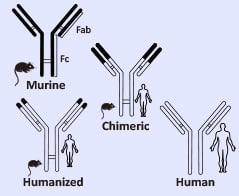
Humanization is a technique to reduce the immunogenicity of a therapeutic antibody
initially derived from rodents
[non-humans]. The process refers to the replacement of more than 90% of rodent
IgG sequence in the parental antibody molecule with human IgG sequence.
Figure 1: Schematic on
right
illustrates
principle.
Affinity maturation is usually applied to antibody leads selected from a naïve human library using a display technology. These leads may have relatively low (10–100 nM) target binding affinities but can be enhanced to reach a desired affinity range (normally 0.1–10 nM). Note that high affinity does not always correlate with improved Ab efficacy.
The Fc region of an Ab is a functional molecular entity mediating
Alteration of each of these activities has been explored to modulate the function of Ab in specific applications. For example, ADCC enhancement improves tumor cell killing, achieved by engineering site-directed mutations in the contact residues. You could also increase Ab half-life by Fc engineering. After the generation of an optimized lead, further functional and molecular characterization is carried out to confirm its in vitro and in vivo activity and favorable molecular attributes as a therapeutic candidate1.
The previous section in this series is "Hit Generation and Screening". To review, click here
You can also view our Recombinant Antibody Service Selection Guide to identify services that are the best match for your application.
Click the quote button,provide service information and submit
Our Technical Account Manager will contact you within 24 hours to finalize quote
You review and approve final order details and price
You provide credit card/PO information and order is plcaed
Project is initiated immediately
Our Project Manager will be in contact with you to provide updates
Our customer service repsentatives are available 24 hours a day, Monday through Friday, to assist you.